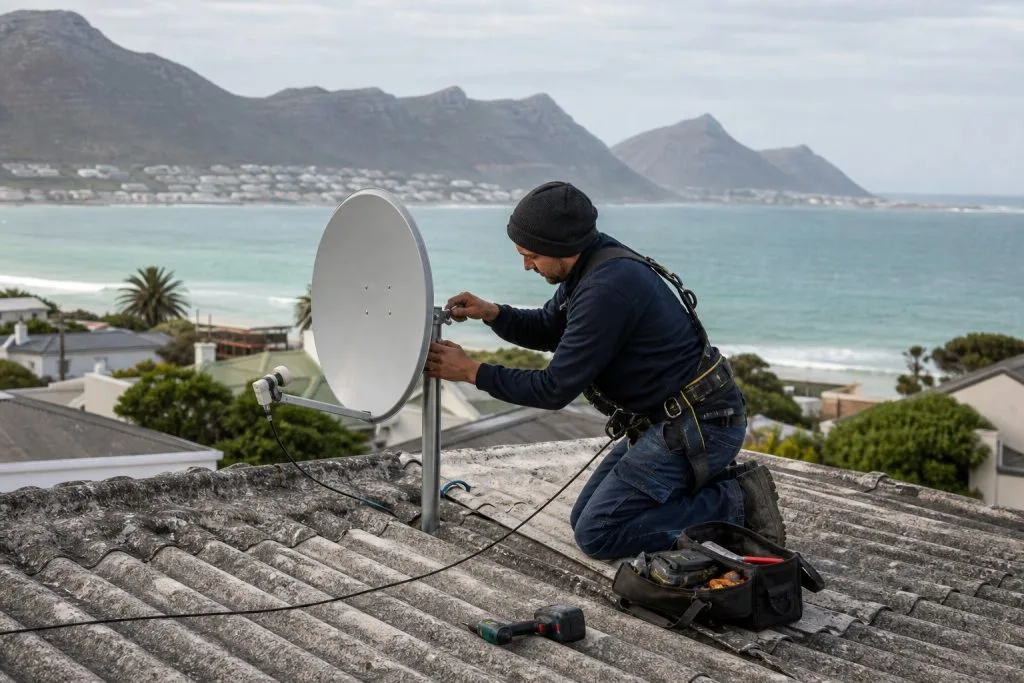
The single biggest difference between a TV install that lasts for years on the Walker Bay coast and one that fails within a season is not the brand of decoder or the size of the dish. It is how the installation handles salt air. Get that right and the same setup runs trouble-free for years; get it wrong and you are paying for repeat call-outs by next summer.
What salt air does to your gear
Salt is relentlessly corrosive, and on an exposed coast like Hermanus it is in the air constantly: not just on the days you can smell the sea. It attacks every metal part of an installation:
- The LNB on the dish arm corrodes at its contacts, degrading the signal it can pick up.
- Brackets and bolts rust and weaken, letting the dish move in the wind.
- Connectors corrode internally, and once the seal is gone, water follows.
- The copper inside cheap coax oxidises, so even an intact-looking cable quietly loses signal.
The result is a slow decline rather than a sudden failure: a picture that pixelates a little more each month until one windy evening it gives up, usually with an E48-32 error on screen.
Why cheap installs fail fast
A budget install uses thin coax, standard galvanised fixings and connectors left unsealed. Inland that is fine for years. On this coast it is a fault waiting to happen: the money saved on the day is borrowed against a string of repair visits later.
What we do differently
Building for the coast is not complicated, but it takes the right materials and the discipline to do every join properly. On every new installation we fit:
- Quality, UV- and weather-resistant cabling with proper shielding.
- Marine-grade brackets and fixings that resist corrosion and hold through the wind.
- Properly sealed connections at every join: the step budget installs skip most.
- Sensible dish positioning that keeps gear out of the worst spray where the site allows.
It costs a little more up front and saves you several times that in call-outs you never make. The same standard applies whether we are mounting a dish, fitting a TV aerial or running cable for CCTV.
Rescuing a setup you already have
If your install is already in place, a good alignment and re-seal can replace corroded connectors, swap a failing LNB and re-secure a loosened mount: bringing an older budget install up to coastal standard without starting from scratch.
If your current setup was never built for the coast, talk to an accredited Hermanus DStv installer: every new DStv installation in Hermanus we do is sealed and mounted for salt air from day one.
On the Walker Bay coast, weather-sealing is not an optional extra: it is the install. Book a technician across Hermanus and the Overberg and we will make sure yours is built to last.