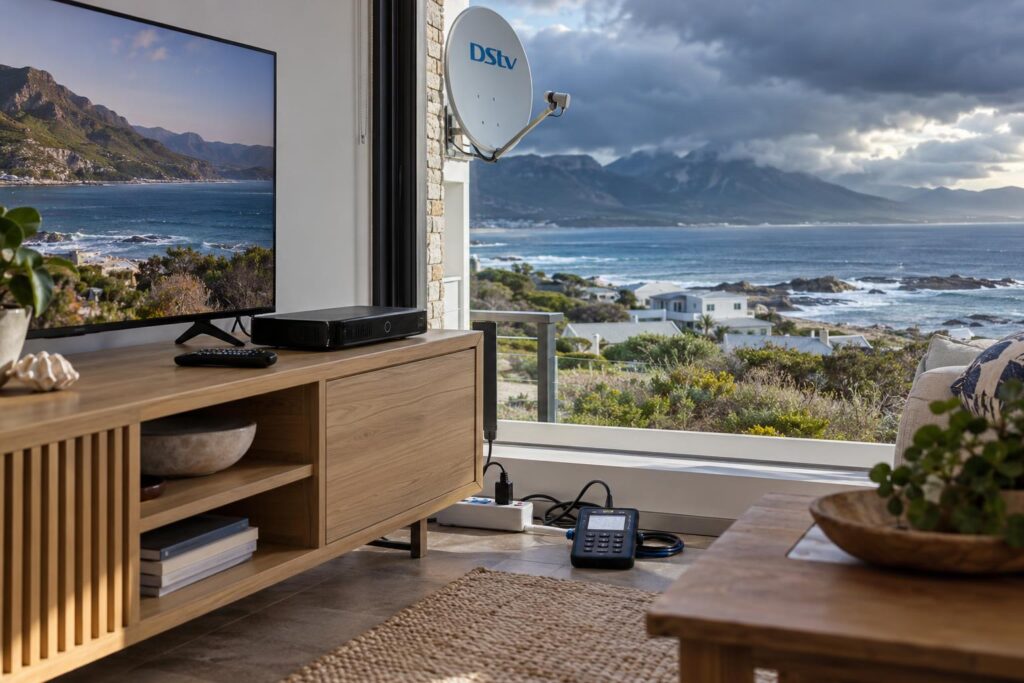
Quick answer: A DStv decoder can be damaged two ways: a spike through the wall plug, or a surge along the dish cable from a nearby lightning strike. A surge protected plug covers the first path only. For real protection, add a properly earthed coax surge protector on the dish cable, and unplug both the power and the dish cable when a big storm is coming.
A decoder is a small computer, and it does not like a sudden spike in the power. This guide covers the DStv decoder surge protection Hermanus homes actually need, and the myths that leave so many boxes unprotected. Good protection costs far less than a new decoder. Yet most lounges we walk into have none at all.
We start with the things people believe, then the facts, then what it means for a house in Onrus, Voelklip or out near Stanford. At the end there is a short checklist you can work through tonight.
DStv decoder surge protection: four myths we hear every month
Most of the damage we see after a storm comes from a belief about DStv decoder surge protection that sounded sensible at the time. Here are the four we hear most, and what is really true.
Myth: load shedding is over, so surges are over
Fact: national load shedding has been suspended for more than a year at the time of writing (October 2026). That helps. But the power still goes off.
Winter cold fronts bring down lines. A fault can trip a whole street in Sandbaai or Vermont. Planned maintenance happens. Every time the power drops and comes back, your electronics take a knock. DStv decoder surge protection still matters.
Myth: my multi-plug protects my decoder
Fact: many cheap multi-plugs have no surge protection at all. They just give you more sockets. Check the packaging or the label for the words "surge protection".
Even a good surge protected plug is only half of DStv decoder surge protection. It guards the power side. It does nothing about the dish cable, which is the path lightning often takes.
Myth: lightning is rare in Hermanus, so why bother
Fact: Hermanus does not get the daily summer thunderstorms of the Highveld. But rare is not never. When a storm does roll in over Walker Bay, a dish on a high roof in Eastcliff or Westcliff is an exposed piece of metal.
A strike does not have to hit your house. A strike nearby can push a surge along power lines and cables into several homes at once.
Myth: DStv insurance pays for everything
Fact: DStv's Device Insurance covers the decoder for loss or damage from fire, lightning, floods, explosions and theft. You can read the details on the official DStv insurance page.
It covers the decoder. It does not cover your TV, your router or the LNB on your roof. The policy wording we read lists lightning, but does not name power surges on their own, so check your terms before you rely on it.
How a surge reaches your decoder: three paths
A decoder is wired into more things than people realise. Each wire is a door a surge can walk through, and good DStv decoder surge protection closes all of them.
Through the wall plug
This is the path everyone thinks of. A spike comes down the mains and into the decoder's power supply. A surge protected plug or a UPS deals with this one.
Through the dish cable
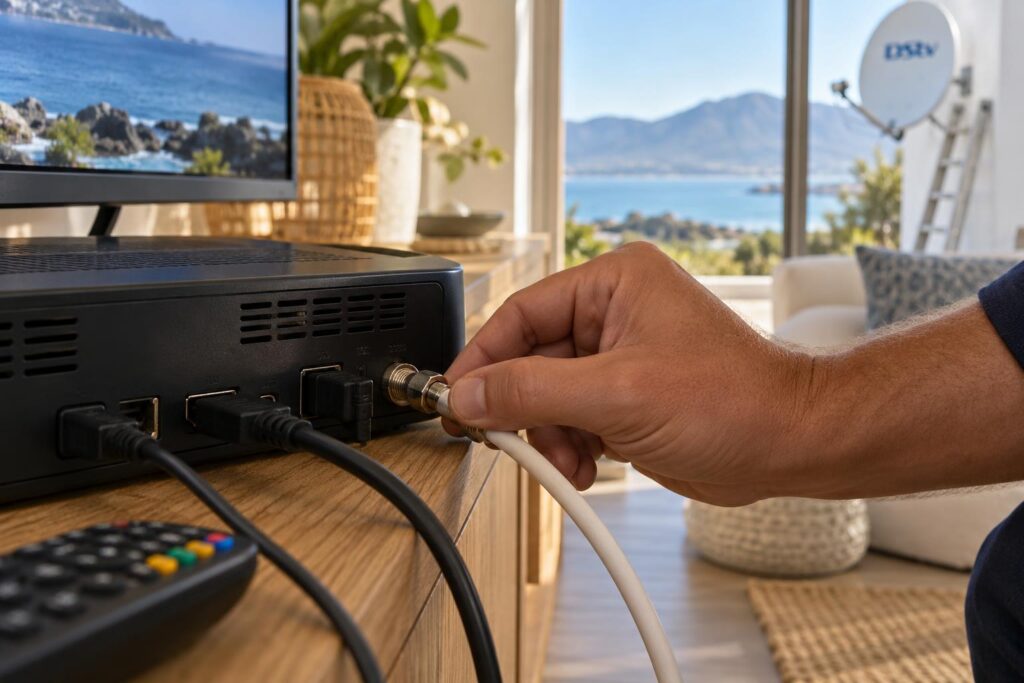
This is the path people forget. The coax runs from a metal dish on your roof straight into the back of the decoder. A nearby lightning strike can send a surge down that cable.
When we test a "dead" box after a storm, we always check the signal at the wall plate too. Our guide on how to check your DStv signal strength shows the same screen we start with.
Through the HDMI and network leads
Your decoder is also connected to the TV by HDMI, and maybe to your router. A surge that enters one device can travel to the next. That is how one storm can kill a decoder, a TV port and a router on the same night.
DStv decoder surge protection options compared
No single product gives full DStv decoder surge protection on its own. Here is how the common options stack up, in plain terms.
| Option | What it covers | What it misses | Our view |
|---|---|---|---|
| Surge protected plug or multi-plug | Spikes on the mains | Anything on the dish cable | The minimum. Every decoder needs one. |
| UPS with surge protection | Mains spikes and short outages | The dish cable | Good for the decoder and router together. |
| Coax surge protector, earthed | Surges along the dish cable | The mains side | Only works with a proper earth. |
| Unplugging in a storm | Every path, while unplugged | Storms that arrive while you are out | Free and very effective. |
| DStv Device Insurance | The decoder, including lightning | TV, router, LNB and cabling | Read the terms if your roof is exposed. |
The best DStv decoder surge protection combines a few of these. A surge protected plug on the mains, an earthed protector on the dish cable, and the habit of unplugging when a big front is forecast.
What to look for in a coax surge protector
Not every coax protector suits a satellite system. Before one goes onto your cable, check these points:
- It is made for satellite signals, not only for a TV aerial.
- It passes power up the cable, because the decoder powers the LNB through the coax.
- It has an earth terminal, and that terminal is actually connected to a proper earth.
- It sits close to where the cable enters the house, not hidden behind the TV.
- Its connectors are sealed if it is fitted outside.
An unearthed protector is just one more joint in the cable. On the coast, an extra joint is an extra place for water and salt to creep in.
Does DStv decoder surge protection need an electrician?
The plug side of DStv decoder surge protection does not. You can buy and fit a surge protected plug yourself. The dish side is different. If your house has no good earth point near the cable entry, an electrician should sort that out first. We are happy to plan it together when we do DStv installation in Hermanus, so the cable and the earth point end up in the same neat spot.
What it means for Hermanus homes
The same storm hits every house differently. Here is how we think about DStv decoder surge protection for the kinds of homes we work in every week.
Holiday homes and lock-up-and-go houses
Many houses in Voelklip, Eastcliff and Kleinmond stand empty for weeks. An empty house cannot pull a plug when the lights flicker. Unplug the decoder, TV and router before you leave, and plug them back in on arrival.
If you let the house to guests, leave a short note by the TV. Our guide to holiday home DStv setup has more ideas for houses that switch between owners and tenants.
Farms and smallholdings
Out towards Stanford and the farms beyond, power often arrives on long overhead lines. Those lines pick up more storm trouble than an underground supply in town. A UPS or a good surge protected plug is worth more here, and so is an earthed coax protector.
Complexes, retirement villages and guesthouses
In a complex in Sandbaai or a retirement village in Vermont, the dish is often shared. A surge on the shared system can reach every unit at once. Ask your body corporate whether the communal system is earthed and protected.
Guesthouses in Fernkloof and Westcliff carry the cost of a dead decoder in every room. When one room loses TV in season, it costs more than the box.
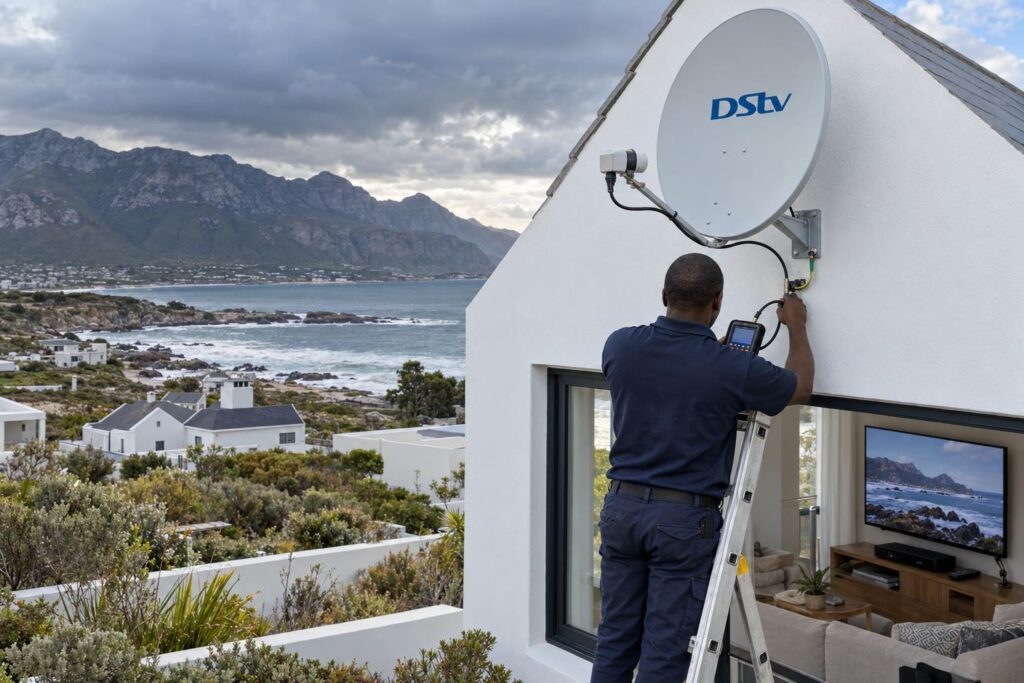
Local tip: If your dish sits on a gable or a high chimney facing the sea in Hawston or Fisherhaven, ask us to look at the earth when we are on the roof. It is far easier to sort while the ladder is already up.
Not sure how protected your decoder is?
We check the plug side and the dish side, and tell you honestly what is worth adding. No hard sell.
A simple storm routine for your decoder
When a big front is forecast, this takes about two minutes. It is the cheapest DStv decoder surge protection there is.
- Switch the decoder off at the wall and pull out the plug.
- Unscrew the dish cable from the back of the decoder. Finger tight only. Never use pliers.
- Unplug the TV and the router too, if you can reach them.
- Wait until the storm has passed and the power has been stable for a while.
- Screw the dish cable back on firmly, then plug the decoder in and switch on.
- Give the decoder a few minutes to start up and update before you judge it.
If an error shows once the power is back, do not panic. Most clear with a restart, and our guide on how to reset your DStv decoder properly walks you through the right order.
During a power cut
Switch the decoder off at the wall while the power is out. When the power returns, wait a few minutes before you switch it back on. The first moments after a restore are often the roughest.
Signs of power surge damage after a storm
After a storm or a power cut, look for these signs. They tell us where to start.
- The decoder will not power on at all.
- The front light comes on, but the TV stays blank.
- The decoder starts up but shows no signal, while the dish has not moved.
- One HDMI port on the TV has stopped working.
- The router died on the same night as the decoder.
- A second room on Extra View lost signal, but the main room is fine.
Decoder or dish? How we tell the difference
No signal after a surge can mean the LNB on the dish is damaged, not the decoder. So we test the signal at the wall before anyone buys anything. Our DStv signal repairs in Hermanus start with exactly that test, so you only replace what has really failed.
If the decoder itself is gone, compare the options before you buy. Our guide to DStv decoder prices in Hermanus shows what you pay at the big retailers.
What surge protection will not fix
DStv decoder surge protection keeps the hardware alive. It does not keep the signal clean. Those are two different jobs.
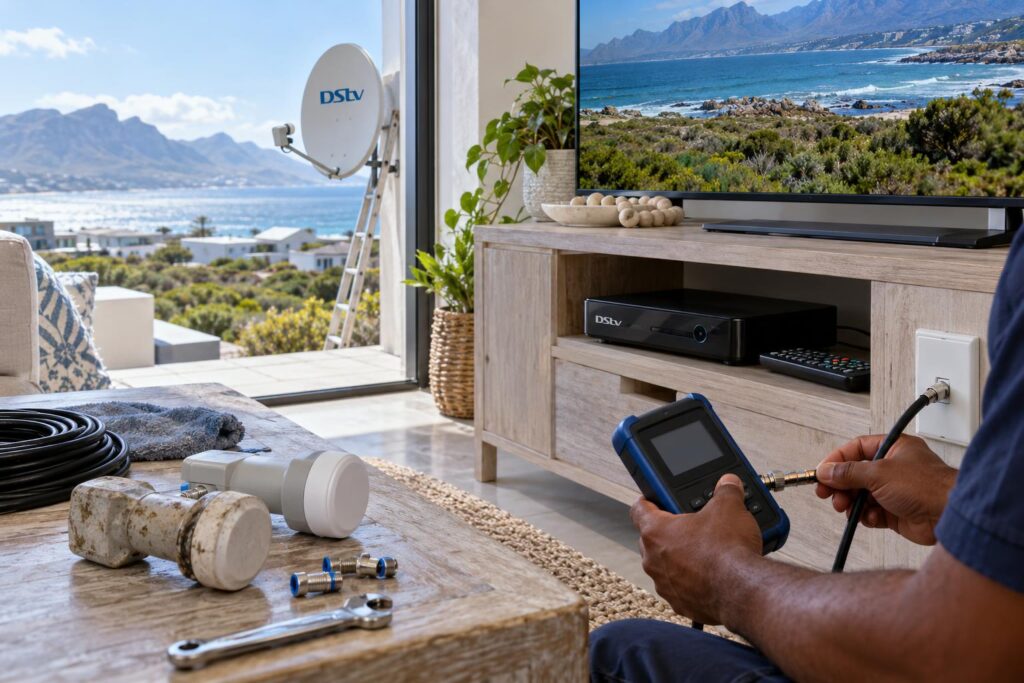
It will not stop the south-easter pushing your dish out of line. It will not stop salt air eating a cheap LNB. It will not help water that has crept into an unsealed connector.
Those are the usual reasons for picture trouble around Walker Bay. If your picture breaks up in wind or rain, read our guide to DStv signal problems in Hermanus first.
A well protected decoder on a badly mounted dish is still a bad setup. You need both, and getting both right is what our Hermanus DStv installers do every day.
Your DStv decoder surge protection checklist
Work through this list once, and again before winter. Tick off what you already have.
Key points for a protected decoder
- The decoder is plugged into a surge protected plug or a UPS, not a plain multi-plug.
- The router and TV share the same protection.
- The dish cable has an earthed, satellite rated surge protector near the cable entry.
- Outdoor connectors are sealed against salt and rain.
- Everyone in the house knows the two minute storm routine.
- Holiday homes are unplugged before you lock up.
- You know what your DStv insurance covers, and what it does not.
If you can tick five or more, your DStv decoder surge protection is in good shape. If not, start with the plug and the storm routine. Both cost little and work tonight.
Decoder dead after a storm?
Do not buy a new box yet. We test the dish, cable and decoder first, then fix only what failed.
DStv decoder surge protection Hermanus FAQs
Is a normal multi-plug enough for DStv decoder surge protection?
Only if it has surge protection built in. Many cheap multi-plugs have none. Even a good one only protects the power side, not the dish cable.
Can lightning damage a DStv decoder through the dish?
Yes. A nearby strike can send a surge down the coax cable from the dish into the decoder. A plug-in protector does not stop this. An earthed coax surge protector, or unplugging the dish cable in a storm, does.
Should I unplug my DStv decoder during a power cut?
It is a good habit. Switch off at the wall while the power is out. Wait a few minutes after the power returns before you switch the decoder back on.
Does DStv insurance cover lightning damage?
DStv says its Device Insurance covers decoder damage from fire, lightning, floods, explosions and theft. It covers the decoder only, not your TV or router. Read the policy terms for the details.
Why is my DStv decoder not working after a power outage?
Often it just needs a few minutes and a proper restart. If it will not power on at all, the power supply may be damaged. If it starts but shows no signal, the LNB or cable may have taken the hit, so a signal test comes first.
Do I need an electrician for DStv decoder surge protection?
Not for the plug side, which you can fit yourself. A coax surge protector needs a proper earth point near the cable entry. If your home does not have one, an electrician should fit it first.